
Best European Countries to Study in 2026: Tuition, Work & Career Paths
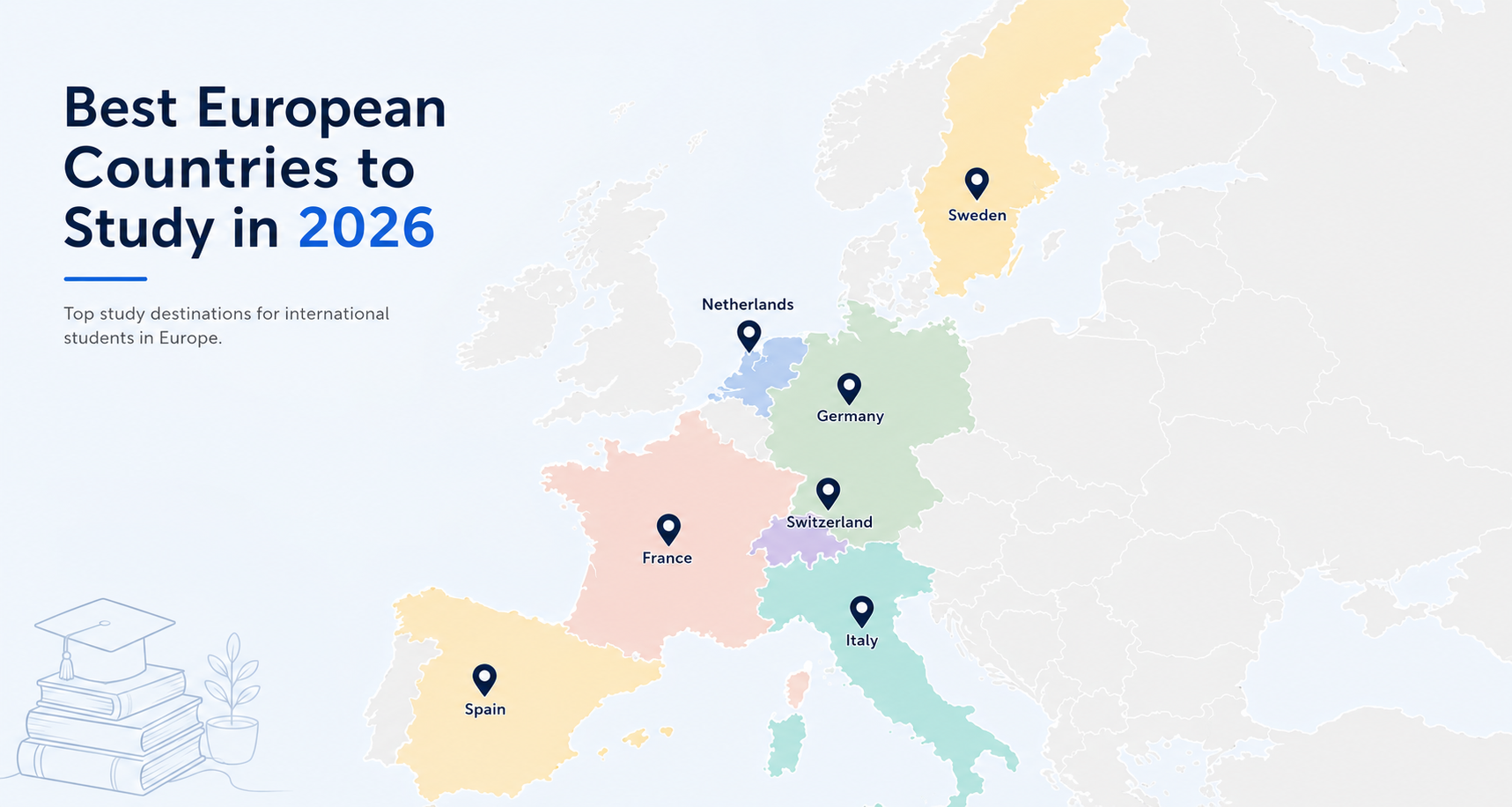
Choosing where to study in Europe is no longer just about finding a good university or the best European countries to study in 2026.
For international students, especially students coming from outside the EU, the bigger question is what happens after admission.
Can you afford the tuition and living costs? Can you work while studying? What happens after graduation? Can you stay and look for a job? And does the country offer genuine opportunities for skilled professionals?
That is why the best European countries to study in 2026 should be judged on more than university rankings.
In this guide, we compare best European countries to study in 2026, Germany, Sweden, Switzerland, Belgium, Spain, the Netherlands, Finland and Lithuania across three factors:
- Affordability and settlement potential
- Education and student pathways
- Career and skilled-work opportunities
The goal is not to tell every student to choose the same country. It is to help you identify which destination makes the most sense for your budget, qualification and long-term plans.
What Should You Consider Before Choosing a European Study Destination?
Before choosing a country, look beyond the advertised tuition fee.
A destination that has low tuition, but expensive accommodation may not actually be affordable. Likewise, a country may have excellent universities but limited opportunities for international graduates who do not speak the local language.
Consider these five questions:
- How much will tuition cost?
- How much will I need for living expenses?
- Can I legally work while studying?
- What happens after I graduate?
- Are there opportunities in my field?
With that in mind, here are eight European destinations worth considering in 2026.
1. Germany: Strongest Overall Balance
Germany is one of the strongest options and one of the best European countries to study in 2026 for international students who want to combine relatively low study costs with strong career opportunities.
At most public universities, international students generally do not pay traditional tuition fees, although there are exceptions and students normally pay a semester contribution. The official German government portal puts the average semester contribution at around €300.
For students from outside the EU, Germany also allows students to work up to 140 full days or 280 half-days per year, or up to 20 hours per week under the applicable working-student arrangement. The biggest advantage, however, comes after graduation.
International graduates can obtain a residence permit for up to 18 months to look for qualified employment. During this period, they can take up employment while searching for a suitable skilled position. Once they secure appropriate employment, they can transition to the relevant work residence status, including an EU Blue Card where eligible.
Why Germany stands out
Affordability: Very strong
Education: Very strong
Career pathway: Very strong
Germany is particularly attractive for students targeting engineering, technology, manufacturing, business, healthcare and other skilled sectors, reasons for being one of the best European countries to study in 2026
Best for: Students who want a strong balance between study costs and post-study career opportunities.
2. Belgium: A Strong Middle Ground
Belgium is an interesting option for students who want access to European education without automatically choosing the most expensive destinations.
For students considering French-speaking Belgium, the 2026–2027 figures are particularly important. Non-EU students who are not exempt can face a total annual registration cost of €5,369, consisting of the registration fee and an additional contribution.
Living costs in French-speaking Belgium are estimated at around €1,000–€1,200 per month, depending on location and lifestyle.
International students can also work during their studies. In French-speaking Belgium, students can work up to 20 hours per week during the academic year, provided the work remains compatible with their studies. During school holidays, there is no hourly limit under the student-work rules described by Wallonie-Bruxelles Campus.
There is also an important post-study pathway: after completing their studies, third-country nationals can request an extension of stay for up to 12 months to look for work or establish a business.
Why Belgium stands out
Affordability: Strong
Education: Strong
Career pathway: Strong
Belgium’s location in the heart of Europe is another advantage for students interested in international business, public policy, logistics, technology, life sciences and related fields.
Best for: Students looking for a balanced European destination with a defined post-study job-search route.
3. Spain: Attractive for Affordability and Lifestyle
Spain remains one of the European destinations worth considering for students who want a combination of education, lifestyle and comparatively manageable living costs in many cities.
The major point to understand is that tuition varies considerably by university, program and region. Students should therefore compare the total cost of the specific program, rather than assuming every Spanish university has the same fee structure.
Spain also permits international students to work under defined conditions. Current immigration rules allow compatible employment of up to 30 hours per week for eligible students.
Spain’s immigration framework has also been undergoing significant changes. The new immigration regulation has made transitions between residence statuses more flexible and expanded employment-related pathways.
That does not mean graduating in Spain automatically leads to permanent residence. Students still need to meet the requirements for the residence or work status they intend to obtain.
Why Spain stands out
Affordability: Strong
Education: Strong
Career pathway: Moderate to strong, depending heavily on sector and language
Spanish language ability can significantly improve employment opportunities, particularly outside highly international sectors.
Best for: Students who want European education, a strong lifestyle proposition and the opportunity to build Spanish-language and international work experience.
4. Netherlands: Excellent Education and Career Potential
The Netherlands is one of Europe’s strongest destinations for students prioritizing English-taught programs, international exposure and career development.
However, affordability needs to be considered carefully.
For 2026–2027, official Study in NL program listings show non-EU tuition fees ranging from roughly €18,000 to €25,000 per year for a number of master’s programs, although fees vary by institution and program. For example, listed programs at Radboud University, Groningen, Wageningen and the University of Amsterdam show different non-EU rates.
Living costs also matter. Study in NL estimates average student expenses at around €1,000–€1,500 per month.
The career pathway is one of the Netherlands’ biggest strengths.
After qualifying, eligible international graduates can apply for the orientation year residence permit, allowing them to stay and look for work or start a business. During the orientation year, graduates can work freely without their employer needing a separate work permit.
Why the Netherlands stands out
Affordability: Moderate to weak
Education: Excellent
Career pathway: Excellent
The Netherlands can make sense for students who have the financial capacity to study there and who are targeting internationally oriented careers.
Best for: Students prioritizing high-quality education, English-taught programs and a strong graduate-to-work pathway.
5. Finland: Excellent Education, But Budget Carefully
Finland offers a strong education system and an attractive environment for international students, but it should not be marketed as a low-cost destination.
For non-EU/EEA students, tuition for English-taught bachelor’s and master’s programs typically ranges from €8,000 to €20,000 per year, depending on the program and institution. Living costs are estimated at approximately €900–€1,200 per month.
Students can work up to 30 hours per week on average during the academic year, with full-time work possible during holidays under the applicable rules. However, Finland’s official study portal warns that finding work can be difficult, particularly without Finnish or Swedish language skills.
After completing a degree, graduates can apply for a residence permit to look for work or start a business. Financial resources are also important; the current requirement for living costs is at least €800 per month for the relevant student residence permit applications.
Why Finland stands out
Affordability: Moderate
Education: Excellent
Career pathway: Strong, but language can matter
Finland is particularly attractive for students interested in technology, sustainability, engineering, education, healthcare and other specialized fields.
Best for: Students who value education quality and are prepared to invest in developing local-language skills for stronger career prospects.
6. Sweden: Premium Education with a Higher Price Tag
Sweden is another strong destination for students looking for high-quality education and an international academic environment. But affordability is not its strongest selling point.
Study in Sweden currently estimates average tuition at around SEK 129,000 per academic year, with programs ranging from approximately SEK 80,000 to SEK 295,000. It estimates living costs at around SEK 10,656 per month.
There are also an important 2026 change students need to know about.
For residence permits granted from 11 June 2026, students at bachelor’s and master’s level may work a maximum of 15 hours per week during studies.
After completing higher education, eligible graduates can receive a residence permit to look for work or explore starting a business. For bachelor’s and master’s graduates, this can be granted for up to one year.
Why Sweden stands out
Affordability: Moderate to weak
Education: Excellent
Career pathway: Strong
Sweden can be particularly attractive for students interested in technology, engineering, sustainability, life sciences and innovation.
Best for: Students who can comfortably finance their studies and want a strong international education and career environment.
7. Lithuania: The Budget-Friendly Option
If affordability is one of your biggest concerns, Lithuania deserves attention and should be considered as best European countries to study in 2026
Official Study in Lithuania figures put average tuition from approximately €1,300 per year for bachelor’s programs and €2,300 per year for master’s programs, although actual fees vary by institution and program.
Living costs can also be considerably lower than in many Western European destinations. Study in Lithuania estimates typical monthly living expenses at around €500–€800, depending on lifestyle and city.
Lithuania also offers a post-study route. International graduates can stay for a period to look for employment and self-employment, with the official Study in Lithuania portal describing a 12-month job-search residence permit, alongside an additional period linked to the end of studies.
There have, however, been changes to student work rules in 2026. New rules introduced restrictions for some bachelor’s students, while master’s and doctoral students retain broader work rights.
Why Lithuania stands out
Affordability: Excellent
Education: Good
Career pathway: Moderate
Lithuania can be particularly attractive for students who need to keep the initial study budget under control while still gaining an EU education.
Best for: Budget-conscious students who are willing to build their career strategically rather than choosing a destination purely for prestige.
8. Switzerland: Excellent, But Not a Budget Destination
Switzerland is where students need to separate low tuition from low total cost.
Some Swiss public universities have surprisingly moderate tuition fees. For example, official 2026 figures from Swiss universities show foreign-student semester fees ranging from hundreds to several thousand Swiss francs depending on the institution. The University of Bern, for example, lists CHF 2,550 per semester for foreign students, while other institutions have considerably lower fees.
The bigger issue is the cost of living.
Switzerland is one of Europe’s more expensive countries, so a student should not assume that relatively modest tuition automatically makes the country affordable.
Work rules also require careful planning. Third-country students may generally work up to 15 hours per week outside holiday periods, and only after six months from the beginning of their studies, subject to the relevant conditions and approvals.
After graduation, third-country graduates from Swiss higher education institutions can stay for six months to look for a job matching their qualifications. They can be admitted despite the normal priority rules for Swiss and EU/EFTA workers where the employment represents an overriding scientific or economic interest.
Why Switzerland stands out as part of the best European countries to study in 2026
Affordability: Weak when total living costs are considered
Education: Excellent
Career pathway: Excellent for the right profile
Switzerland is particularly attractive for students targeting finance, pharmaceuticals, engineering, hospitality, technology and other specialized sectors.
Best for: Students with strong financial preparation and a clear professional target.

Which of the Best European Countries to Study in 2026 Is Right for You?
There is no single winner for every international student.
The better question is: which country fits your priorities?
| Priority | Strongest options |
|---|---|
| Lower tuition | Germany, Lithuania |
| Overall balance | Germany, Belgium |
| English-taught international education | Netherlands, Sweden, Finland |
| Strong post-study job-search pathway | Germany, Netherlands, Belgium |
| Lower living-cost potential | Lithuania, Spain |
| Premium education and specialized careers | Switzerland, Sweden, Netherlands |
| Student work opportunities | Germany, Finland, Belgium |
| Budget-conscious students | Lithuania, Germany |
| Students targeting skilled careers | Germany, Netherlands, Sweden, Finland |
Frequently Asked Questions
Which are the best European countries to study in 2026?
Germany, Belgium, Spain, the Netherlands, Finland, Sweden, Lithuania and Switzerland are all worth considering, but the best choice depends on tuition, living costs, work opportunities and post-study career options and they’re all categorized as the best European countries to study in 2026.
Which European country is cheapest for international students?
Lithuania and Germany can be among the more affordable options, although the total cost depends on the university, program, city and student’s lifestyle.
Which European country is best for international students after graduation?
Germany and the Netherlands have particularly notable post-study pathways, but students should assess the requirements for their specific qualification and career.
Can international students work while studying in Europe?
Yes, but the number of hours and conditions vary by country and residence status. Students should always check the current rules with the relevant immigration authority.
The Bottom Line
The best European countries to study in 2026 are not necessarily the countries with the cheapest tuition or the highest-ranked universities.
They are the countries where your education, finances and career plans work together.
Germany currently offers one of the strongest overall combinations of low public-university tuition, student work options and an 18-month graduate job-search pathway.
Lithuania stands out for students who need a more affordable entry point.
Belgium offers a compelling middle ground, particularly for students who want European education and a defined 12-month post-study job-search route. that’s why it one of the best European countries to study in 2026.
The Netherlands offers excellent education and a strong graduate career pathway, but students need a larger budget.
Finland and Sweden provide high-quality education and strong professional environments, but the cost of study and living needs to be planned carefully.
Spain can be attractive for students who value affordability, lifestyle and the opportunity to develop Spanish-language skills.
Switzerland offers an impressive education and career environment, but its high living costs make financial planning essential.
The important thing is not to choose a country because it is trending on social media, or the one you think is part of the best European countries to study in 2026.
Choose the country that makes sense for the degree you want, the money you can realistically spend and the career you want after graduation.
Ready to choose your European study destination?
Don’t start with the question, “Which country is easiest?”
Start with: “Which country gives me the best chance of turning my degree into a career?”
If you need help comparing programs, admission requirements and study destinations, speak with the Hitouch Global team before making your decision.
“If Canada is also on your list, compare it with Europe in our guide to “Best Cities in Canada for International Students.”