
Study in New Zealand for International Students | 2027 Guide
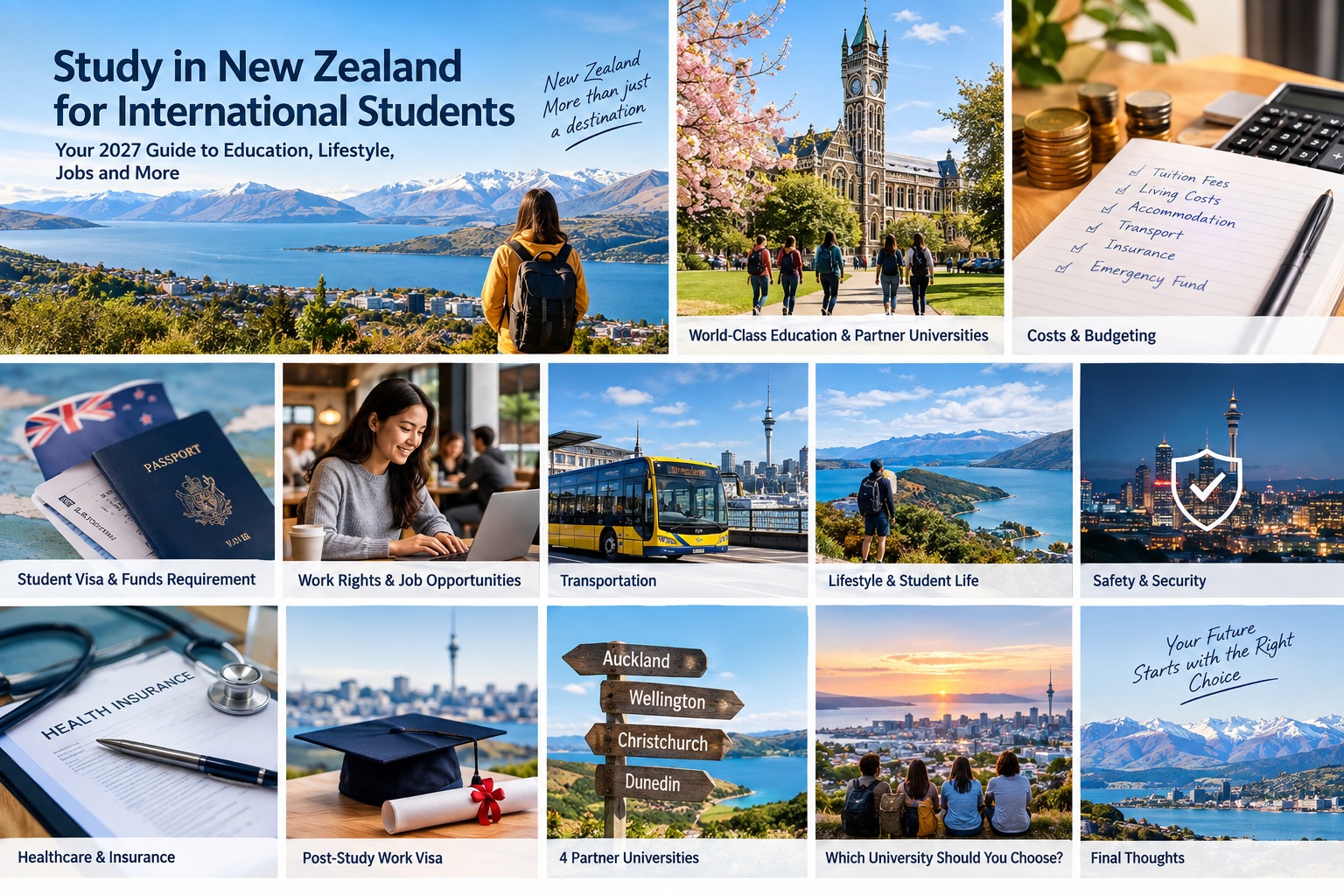
Study in New Zealand for International Students: Why It Deserves a Place on Your 2027 List
When international students think about studying abroad, the usual destinations that come to mind are Canada, the UK, Australia, and the United States.
But what if you expanded your list?
New Zealand deserves serious consideration for students planning to study abroad in 2027.
From internationally recognized education and student work opportunities to its outdoor lifestyle, public transport, student support systems and post-study work options, New Zealand offers more than just a university degree.
But choosing a study destination should not be based on attractive pictures or promises of an easy route to permanent residence.
You need to understand the cost, work rights, lifestyle, transportation, healthcare, safety, career opportunities and immigration rules before making your decision.
So, what does it really mean to study in New Zealand for international students in 2027?
Let’s look at the practical side.

Why Study in New Zealand for International Students?
New Zealand offers an English-speaking education environment with universities and other recognized education providers across a wide range of disciplines.
It can also provide international students with opportunities to work during eligible studies and, for eligible graduates, apply for post-study work options.
But perhaps one of its biggest attractions is the combination of education and lifestyle.
Students can study in cities such as Auckland, Wellington, Christchurch and Dunedin while also having access to beaches, mountains, outdoor activities and a different pace of life from some of the world’s larger study destinations.
The important question is not simply whether New Zealand has benefits.
It is whether New Zealand fits your academic goals, budget and career plans.
1. How Much Does It Cost to Study in New Zealand?
This is one of the first questions international students should ask. There is no single tuition fee for studying in New Zealand. Tuition varies according to:
The university or education provider, your programme, your level of study, the number of courses or papers you take, the length of your programme
Official Study with New Zealand guidance confirms that international tuition fees vary depending on the type of course, where you study and how long you study.
For example, the University of Waikato’s official 2027 estimates show that a Bachelor of Arts may cost approximately NZD $34,020-$44,342, while a 120-point Master of Business is estimated at NZD $43,239 and a 120-point Master of Cyber Security at NZD $48,308. These are indicative figures and are subject to change.
The University of Otago also explains that its international tuition is generally calculated according to the papers a student takes, meaning the actual cost can vary depending on the programme and subject combination.
What about living costs?
Your tuition is only part of your study-abroad budget.
Official New Zealand guidance currently gives examples including Shared-house accommodation from around NZD $140 per week, Catered halls of residence from around NZD $484 per week, Basic groceries of around NZD $80–$120 per week, public transport of up to around NZD $37 per week, depending on location and distance, Mobile phone plans from around NZD $19 per month, Unlimited Wi-Fi for a shared flat averaging around NZD $90 per month, These are examples, not a guaranteed student budget.
Your actual costs will depend on where you live, your accommodation, transport needs and lifestyle.
2. How Much Money Do You Need for a New Zealand Student Visa?
This is where students need to distinguish between actual living costs and the amount Immigration New Zealand requires you to demonstrate for your visa.
For tertiary-level study of one year or more, Immigration New Zealand currently requires evidence of NZD $20,000 per year for living costs.
For courses shorter than one year, the requirement is currently NZD $1,667 per month.
This is separate from tuition fees and money required for outward travel.
That means you should not create your study-abroad budget on the assumption that you will arrive in New Zealand and immediately earn enough from part-time work to cover everything.
Your finances need to make sense before you travel.
3. Can International Students Work in New Zealand?
Yes, eligible international students may be able to work while studying.
Under current Immigration New Zealand rules, eligible students can work up to 25 hours per week during their studies, with the exact conditions depending on their course and visa.
Some students can also work full-time during scheduled holidays.
However, there is an important detail:
A New Zealand student visa does not automatically give every student the same work rights.
Your work conditions are recorded on your eVisa or visa letter.
Students should therefore check their specific visa conditions before accepting employment.
Part-time work can help students manage some everyday expenses and gain local work experience, but it should be treated as an addition to your financial plan rather than the foundation of it.

4. What Jobs Can International Students Do?
The jobs available to international students depend on the local labour market, location, skills, experience and the student’s work rights.
Students may find opportunities in areas such as Hospitality, Retail, Customer service, Administration, Tourism, Events, Campus-related roles, other sectors recruiting part-time workers.
But there is a bigger question students should ask:
What happens after graduation?
A part-time student job and a professional career are two different things.
When choosing a programme, consider whether the qualification connects with your intended career, whether practical experience is available and what post-study options may apply to your qualification.
That is why choosing your course should come before choosing your part-time job.
5. What Is Transportation Like in New Zealand?
Transportation is another everyday issue that can significantly affect your budget.
New Zealand has public transport systems including buses, trains and ferries, depending on the city or region. Your costs will depend on where you live and how far you travel to campus.
Official Study with New Zealand guidance currently estimates public transport costs of up to around NZD $37 per week, depending on where you live and study.
When choosing accommodation, don’t look at rent alone.
Ask:
- How far is the accommodation from campus?
- How long will the daily journey take?
- Is public transport easily accessible?
- How much will transportation cost each week?
- Are supermarkets and other essential services nearby?
A room that costs less but requires expensive daily transportation may not actually save you money.
6. Is New Zealand Safe for International Students?
Safety matters when moving to another country.
Rather than describing any destination as completely risk-free, students should look at the systems available to support international learners. New Zealand has a government-administered Pastoral Care Code of Practice for tertiary and international learners.
Under the Code, education providers must support learner wellbeing and safety and provide students with information and support to help them make informed choices about education and life in New Zealand.
International students should still take normal precautions to Secure important documents, understand local laws, choose accommodation carefully, learn emergency procedures, know where student support services are located, Maintain appropriate insurance, Keep emergency contacts accessible.
Safety is not just about crime statistics.
It is also about knowing that there are systems and people you can turn to when you need help.
7. What About Healthcare and Insurance?
International students need to plan for healthcare before travelling.
Immigration New Zealand requires student visa applicants to agree to have acceptable medical and travel insurance for their stay, subject to the applicable rules. The student’s education provider will explain the insurance requirements or may arrange an appropriate policy.
Students should understand what their insurance covers, what exclusions apply, how to access healthcare, how claims work, what to do in an emergency.
Do not assume that being an international student means all healthcare will be free. Healthcare and insurance should therefore be included in your study-abroad financial planning.

8. What Is Student Life Like in New Zealand?
Studying abroad is not only about classrooms and assignments, but your lifestyle can also have a major impact on your overall experience. New Zealand offers opportunities for students who enjoy:
Outdoor activities, Beaches and coastal environments, Hiking and nature, Sports, Smaller-city environments, Multicultural student communities, A balance between academic and personal life
The experience will also depend heavily on where you study.
Wellington offers a capital-city environment. Dunedin has a strong student identity. Other cities provide different combinations of cost, transport, culture and lifestyle.
So instead of asking:
“Is New Zealand the best country to study in?”
Ask:
“Does the New Zealand lifestyle fit the life I want while studying?”
9. What Happens After Graduation?
For many students, the period after graduation is just as important as the degree itself.
New Zealand currently has a Post Study Work Visa for eligible graduates.
Depending on the qualification and circumstances, eligible graduates can stay and work in New Zealand for up to three years.
The rules depend on the qualification completed and other eligibility requirements.
There are also changes taking effect from 16 November 2026. Immigration New Zealand says Post Study Work Visa eligibility will be extended to certain applicants who complete an NZQCF Level 7 Graduate Diploma in New Zealand and hold a bachelor’s degree completed in New Zealand or overseas.
For anyone planning a 2027 intake, this is important.
Do not rely on an old TikTok, YouTube video or blog post about post-study work rights.
Check the current Immigration New Zealand rules for the qualification you intend to study.
10. Does Studying in New Zealand Guarantee Permanent Residence?
No.
This is one of the most important points prospective students need to understand.
Studying in New Zealand does not automatically lead to permanent residence.
A New Zealand qualification can potentially form part of a longer-term career and immigration plan, but residence depends on the specific immigration pathway and whether the applicant meets the requirements that apply at that time.
Your research should therefore go beyond:
“Which course can get me PR?”
Instead, ask:
- What qualification am I studying?
- What career do I want after graduation?
- What occupations are relevant to that career?
- What work rights will I have after graduation?
- What residence pathways could potentially apply?
- What requirements would I need to meet?
- Could the rules change before I graduate?
This approach gives you a much more realistic study-abroad plan.

11. Four New Zealand Universities to Explore Through Hitouch Global
If you are considering study in New Zealand for international students, choosing the right institution is just as important as choosing the country.
Hitouch Global works with partner institutions in New Zealand, giving prospective students several options to explore based on their academic background, program interests, budget and career goals.
University of Otago
The University of Otago is one of New Zealand’s universities with a broad range of undergraduate and postgraduate study options.
Its official information for international students includes program-specific tuition information and scholarship opportunities.
For 2027, Otago lists international scholarship opportunities including selected undergraduate and postgraduate awards. Scholarship eligibility varies according to nationality, program and other conditions, so students should check the specific scholarship requirements before applying.
Otago’s international tuition fees also vary by academic division and program rather than following one universal international fee.
University of Waikato
The University of Waikato offers programs across areas including business, computing, science, education, engineering, management, tourism and other disciplines. Its official 2027 international tuition information is already available.
For example, current 2027 indicative fees include Bachelor of Arts: approximately NZD $34,020–$44,342, Master of Business, 120 points: approximately NZD $43,239, Master of Cyber Security, 120 points: approximately NZD $48,308, Master of Data Science: approximately NZD $71,789 for 180 points. These are indicative estimates, and actual fees depend on the papers and qualification.
That makes Waikato an option worth exploring for students interested in areas such as business, technology, computing and other academic fields.
Victoria University of Wellington
Victoria University of Wellington gives students the opportunity to study in New Zealand’s capital city. The university offers programs across a broad range of disciplines, and international tuition fees depend on the courses and points included in a student’s program.
The university has published its 2027 Fees Schedule, alongside information about compulsory fees and other possible costs. Its 2027 Student Services Fee, for example, is calculated according to the number of points taken and whether the student is studying within the Wellington region or elsewhere.
Students should therefore check the specific fee schedule for their intended qualification before preparing their budget.
Lincoln University
Lincoln University is another option for international students considering New Zealand.
Its program-based fee structure means that international tuition fees depend on the program of study.
The university has published separate 2026 and 2027 international tuition fee information, allowing prospective students to check the costs associated with their intended program.
Lincoln can be particularly relevant for students exploring areas connected with agriculture, land, environment, business and related disciplines.
International PhD students may also be eligible for domestic tuition fees when they meet the university’s applicable requirements.
12. Which New Zealand University Should You Choose?
There is no single university that is right for every international student.
Your decision should be based on factors such as Your academic qualifications, your intended program, Entry requirements, tuition fees, Scholarship opportunities, Location, Accommodation and living costs, Career objectives, post-study options, Your overall financial position
In other words:
Choose the programme first. Then compare the institutions that can help you reach your goal.
The cheapest programme is not automatically the right programme, and the most famous university is not automatically the right fit either.
13. What Should You Budget for Before Moving to New Zealand?
Before accepting an offer, build a realistic financial plan. Your budget should account for:
Education
Tuition fees, Student services or compulsory fees, Study materials, Programme-specific expenses
Accommodation
Rent, Bond or deposit, Utilities, Internet, Furniture, where applicable
Everyday living
Groceries, Phone, Transportation, Clothing, Personal expenses
Immigration and travel
Student visa costs, Insurance, Flight, Outward travel funds, Airport or initial relocation costs
Emergency funds
Do not plan your budget down to your last dollar. Unexpected expenses happen. A strong study-abroad financial plan leaves room for them.
14. Is New Zealand Worth Considering for 2027?
If you have only been looking at Canada, Australia, the UK or the United States, expanding your research could reveal options you had not previously considered.
New Zealand offers:
English-language education, A range of universities and programmes, Eligible student work opportunities, A distinctive lifestyle, public transport options, Student wellbeing and support frameworks, post-study work opportunities for eligible graduates, Multiple university choices.
But there are also realities you need to prepare for:
- Tuition fees can be significant
- Living costs vary by location
- You need sufficient funds for your visa
- Insurance is required under the applicable student-visa rules
- Part-time work should not be treated as your primary funding source
- Post-study work depends on eligibility
- Permanent residence is not automatic
- Immigration rules can change
That is why the smartest approach is not to ask:
“Which country is easiest?”
Ask:
“Which destination, program and career pathway make sense for me?”

Final Thoughts
New Zealand may not be the first country that comes to mind when you think about studying abroad.
That is exactly why it deserves a closer look.
For the right student, it can combine quality education, an international environment, work opportunities during eligible studies, a distinctive lifestyle and potential post-study opportunities.
But don’t make the decision based on a social-media claim that New Zealand is “easy,” “cheap” or a guaranteed route to permanent residence.
Do the numbers. Check the rules. Research the program. Understand the career pathway.
Then make your decision based on your actual goals.
Ready to explore studying in New Zealand?
Hitouch Global can help you explore study options across our New Zealand partner universities, including the University of Otago, University of Waikato, Victoria University of Wellington and Lincoln University.
From choosing a suitable programme to preparing your application and understanding the student-visa process, getting the right information early can make your study-abroad journey much clearer.
Your next destination doesn’t have to be the obvious one. It has to be the right one for your future.
Talk to Hitouch Global about your New Zealand study options today.
Frequently Asked Questions
Is New Zealand good for international students?
New Zealand offers international students a range of education options, eligible work opportunities during study and post-study work options for eligible graduates. Students should also consider tuition, living costs, visa requirements and their intended career pathway before applying.
How much money do international students need for New Zealand?
For tertiary-level study of one year or more, Immigration New Zealand currently requires evidence of NZD $20,000 per year for living costs. This is separate from tuition fees and outward-travel funds.
Can international students work while studying in New Zealand?
Eligible international students may be able to work up to 25 hours per week, with the exact conditions depending on their course and student visa. Some students may also have full-time work rights during scheduled holidays.
Can I stay in New Zealand after graduation?
Eligible graduates may be able to apply for a Post Study Work Visa. Depending on the qualification and circumstances, the visa can allow eligible graduates to stay and work in New Zealand for up to three years.
Does studying in New Zealand guarantee PR?
No. Studying in New Zealand does not automatically lead to permanent residence. Any future residence application depends on the relevant immigration pathway and whether the applicant meets its requirements.
How much does tuition cost in New Zealand?
There is no single international tuition fee. Costs vary by university, programme, qualification and course load. For example, the University of Waikato publishes different 2027 indicative fees for different qualifications, while Otago calculates many fees according to the papers and subjects taken.
Which New Zealand universities can international students explore through Hitouch Global?
Hitouch Global’s New Zealand partner network includes the University of Otago, University of Waikato, Victoria University of Wellington and Lincoln University. Programme availability, entry requirements, tuition and scholarship eligibility vary by institution.
Is health insurance required for international students in New Zealand?
Student visa applicants generally need to agree to have acceptable medical and travel insurance for their stay, subject to the applicable rules. Students should confirm the requirements with their education provider and Immigration New Zealand.
Is New Zealand safe for international students?
New Zealand has a government-administered pastoral-care framework requiring participating education providers to support the wellbeing and safety of tertiary and international learners. Students should still take normal personal-safety precautions and understand the support available at their institution.
What should I consider before choosing a New Zealand university?
Consider your intended programme, entry requirements, tuition, scholarships, location, accommodation and living costs, career objectives and post-study options. Your university choice should support your overall academic and career plan.
Information note: Immigration rules, tuition fees, scholarship conditions and other study-abroad requirements can change. The information in this article reflects official sources checked in September 2026. Students should verify the requirements applicable to their programme, intake and visa application before making financial or immigration decisions.