
Study Abroad Checklist 2027: The Complete Step-by-Step Guide
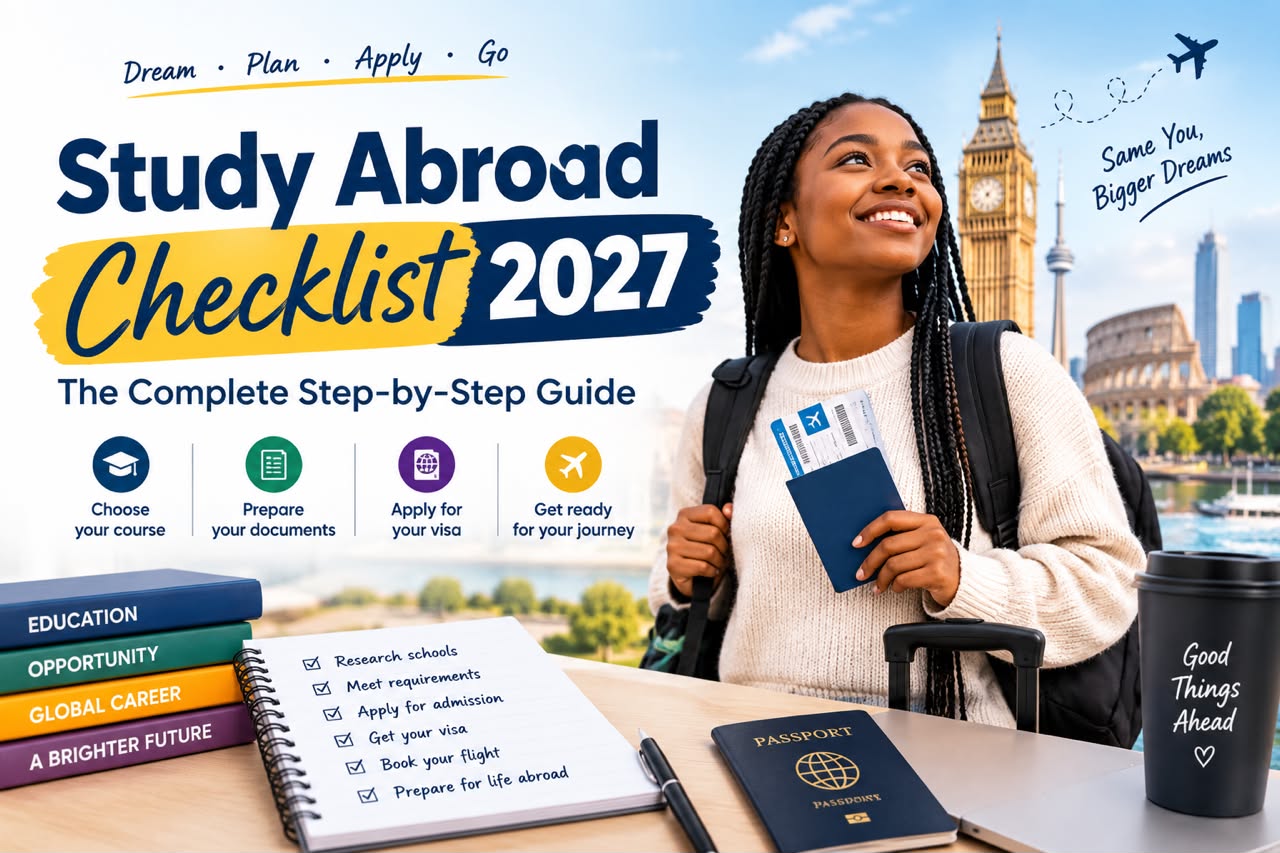
Planning to study abroad in 2027?
Getting an admission letter is only one part of the process. Choosing the wrong course, missing an important document, underestimating your budget, or starting your visa preparation too late can turn an exciting plan into an expensive mistake.
That is why having a study abroad checklist matters.
This guide walks you through the major steps, from deciding where and what to study to preparing your documents, applying to your school, getting your student visa, and preparing for departure.
Use it as your 2027 study abroad action plan and work through each step before moving to the next.
Study Abroad Checklist at a Glance
Before we get into the details, here is your quick checklist:
- Define your study and career goals
- Choose your preferred study destination
- Select a suitable course or program
- Research universities and colleges
- Check admission requirements
- Calculate your complete study-abroad budget
- Research scholarships and funding
- Prepare your academic and personal documents
- Check English-language requirements
- Submit your school applications
- Review your admission offer
- Prepare your student visa application
- Arrange accommodation
- Book your flight
- Prepare for arrival
- Keep copies of your important documents
Now let’s break each step down.
1. Define Your Study Abroad Goals
Before searching for schools, ask yourself why you want to study abroad and what you want to achieve from the experience.
Consider:
- What career do I want to pursue?
- What qualification do I need?
- Which countries are strong in my field?
- What type of institution suits me?
- What is my realistic budget?
- Do I want to work after graduation?
- What are my long-term career plans?
Your answers should guide your destination and course choices. Don’t choose a country simply because it is popular on social media. A destination that works for one student may be completely unsuitable for another.

2. Choose the Right Study Destination
Your next step is to compare potential countries. Look beyond tuition fees.
Consider Cost of living, Quality of education, Admission requirements, Student visa requirements, Available programs, Scholarship opportunities, post-study work options, Employment opportunities, Housing availability, Climate and lifestyle, Travel and transportation, Long-term career opportunities
For example, Canada, the UK, Germany, France, Ireland, Australia, Spain and other European destinations all have different education systems, immigration rules and costs.
The cheapest tuition does not necessarily mean the cheapest study-abroad experience.
3. Choose Your Course and Career Path
Your course should make sense academically and professionally.
Research the Course content, Duration, Entry requirements, Tuition fees, Career opportunities, Industry demand, Internship or practical training opportunities, and whether the qualification supports your long-term career goals.
Avoid choosing a program simply because someone told you it is “easy” or because you saw it trending online. Your study plan should tell a coherent story: where you have been professionally or academically, what you want to learn, and how the program helps you move forward.
4. Research and Compare Schools
Once you know what you want to study, create a shortlist of institutions. Don’t apply randomly.
For each school, compare:
| What to Check | Why It Matters |
|---|---|
| Program | Does it match your career goals? |
| Tuition | Can you realistically afford it? |
| Entry requirements | Are you eligible? |
| Location | Does the city fit your budget and lifestyle? |
| Start date | Can you prepare in time? |
| Institution reputation | Does it offer credible education? |
| Scholarships | Could you reduce your costs? |
| Student support | What support is available to international students? |
Ideally, have a few options rather than depending entirely on one school.
5. Check Admission Requirements
Every institution and program can have different requirements. Depending on your course and destination, you may need:
- Academic certificates
- Academic transcripts
- Passport
- Curriculum vitae/resume
- Statement of purpose or personal statement
- Recommendation letters
- Proof of English proficiency
- Portfolio
- Professional experience
- Application forms
- Application fees
Do not assume that meeting the general requirements automatically means you qualify for your chosen program.
Always check the requirements for the specific institution and program.

6. Calculate Your Real Study Abroad Budget
This is one of the most important parts of your checklist. Your budget should include more than tuition.
Before departure
Application fees, Tuition or deposit, English test fees, Document processing, Visa application fees, Medical or biometric requirements where applicable, Insurance, Flight ticket, and Accommodation deposit.
After arrival
Rent, Food, Transportation, Utilities, Study materials, Phone and internet, Personal expenses, and Emergency funds.
Create a budget before accepting an offer, not after. You should know how you intend to finance your studies and living expenses before committing to the move.
7. Research Scholarships and Funding
Don’t assume scholarships are only available to students with perfect grades. Search for University scholarships, Government-funded scholarships, Country-specific scholarships, Merit-based awards, Need-based funding, External education grants.
Check eligibility, deadlines and application requirements carefully. Also remember that a scholarship may cover only part of your expenses. Understand exactly what is included before relying on it in your financial plan.
8. Prepare Your Documents
Start preparing your documents early. A basic study abroad document checklist may include:
Valid passport, Academic certificates, Academic transcripts, CV/resume, Statement of purpose, Recommendation letters, English-language test result, where required, Passport photographs, where required, Proof of funds, where required, Admission/offer letter, Tuition payment receipt, where applicable, Visa documents, Accommodation information, and Travel insurance, where applicable
Some documents may need certification, translation or additional verification.
Don’t wait until your visa appointment to discover that a document needs to be corrected or translated.
9. Check English-Language Requirements
Depending on your destination, institution and previous education, you may need to provide evidence of English proficiency. Possible tests include IELTS, TOEFL, PTE, and other institution-approved tests.
Requirements vary, so check your chosen institution rather than assuming one test or score applies everywhere. If you need a test, factor the test date, result-release timeline and possible retake into your application schedule.
10. Submit Your School Applications
Before submitting an application, check everything one more time.
Make sure Your personal information is correct, your academic history is accurate, your documents are complete, your statement has been proofread, your references are correctly provided, your application meets the deadline, your program and intake are correct.
Keep a record of:
School – Program – Application date – Application status – Deadline – Offer
This simple tracking system can prevent missed deadlines and confusion when applying to multiple institutions.
11. Review Your Admission Offer Carefully
Congratulations, but don’t rush to celebrate and immediately pay. Read the offer carefully.
Check Program name, Intake, Tuition fees, Deposit requirements, Payment deadline, Conditions attached to the offer, Refund policy, Required documents, Next steps.
If the offer is conditional, understand exactly what you need to do to make it unconditional.

12. Start Your Student Visa Preparation
Your admission letter is not your visa. Visa requirements differ by country, so always use the official immigration information for your destination.
Depending on the country, you may need documents such as:
- Valid passport
- Admission letter
- Proof of funds
- Tuition payment evidence
- Accommodation details
- Medical documentation where required
- Police or background documentation where required
- Visa application forms
- Biometrics
- Passport photographs
- Evidence supporting your study plans
Start preparing early.
A strong school application does not automatically guarantee visa approval. Your visa application must independently satisfy the relevant immigration requirements.
13. Arrange Accommodation
Do not leave accommodation until the last minute.
Research – Student residences, University accommodation, Private rentals, Shared accommodation, Location relative to campus, Transportation, Monthly rent, Deposits, Utilities, Contract terms.
Be especially careful with online accommodation scams. Don’t transfer money simply because someone sends you photographs of a beautiful apartment.
14. Prepare for Your Flight and Arrival
Once your visa and travel plans are confirmed, start preparing for the move.
Create a departure checklist Book flight, confirm accommodation, arrange airport transportation, Pack essential documents, carry important medication where applicable, prepare emergency contacts, save copies of important documents, inform your bank, if necessary, arrange phone/internet access, Prepare some local currency, Check baggage allowance.
Keep your critical documents in your hand luggage, not your checked baggage.
15. Create a Digital Document Backup
This step is easy to overlook.
Create a secure digital folder containing copies of Passport, Admission letter, Visa, Academic documents, Accommodation confirmation, Flight information, Insurance, Emergency contacts, financial documents, important school correspondence.
Keep your digital copies accessible even if you lose your physical documents.
Your Final Study Abroad Checklist for 2027
Before you leave, ask yourself:
Education
☐ Have I confirmed my program and start date?
☐ Have I completed all admission requirements?
☐ Have I paid the required tuition/deposit?
Finances
☐ Have I calculated my tuition and living expenses?
☐ Do I have access to sufficient funds?
☐ Do I have an emergency fund?
Visa
☐ Is my visa approved?
☐ Do I have all my visa documents?
☐ Have I checked the conditions attached to my visa?
Travel
☐ Is my flight confirmed?
☐ Is my accommodation confirmed?
☐ Do I know how I will get from the airport to my accommodation?
Personal preparation
☐ Do I have my important documents?
☐ Do I have digital backups?
☐ Do I have emergency contacts?
☐ Have I researched my destination and institution?
If you can confidently tick these boxes, you’re no longer just thinking about studying abroad you’re preparing to actually do it.
When Should You Start Planning to Study Abroad?
Ideally, start 9-12 months before your intended intake.
A simple planning timeline could look like this:
12 months before:
Choose your destination, course and schools.
9 – 10 months before:
Prepare documents, check requirements and begin applications.
6 – 8 months before:
Submit applications and research funding opportunities.
4 – 6 months before:
Review your offer, meet conditions and begin visa preparation.
2 – 3 months before:
Arrange accommodation, travel and remaining documentation.
1 month before:
Finalize packing, finances, travel arrangements and arrival plans.
The exact timeline varies by country, institution and intake, so always check the deadlines that apply to your specific application.
Common Study Abroad Mistakes to Avoid
1. Choosing a country before choosing a career direction
Start with your goals, then identify destinations that support them.
2. Looking only at tuition fees
Your total cost includes tuition, housing, food, transportation, insurance, visa expenses and other living costs.
3. Applying without checking requirements
A program may have requirements that differ from the general university requirements.
4. Starting the visa process too late
Give yourself enough time to gather documents and address unexpected issues.
5. Relying on social media for immigration information
Immigration rules change. Use official government sources for visa requirements and conditions.
6. Choosing a program simply because it is popular
The best program is one that makes sense for your academic background and career direction.
7. Paying before understanding what you are paying for
Understand fees, deadlines, refund conditions and what is included before making significant payments.
Final Thoughts: Don’t Just Apply – Plan
Studying abroad can change your education, career and personal life, but the process requires more than finding a school and submitting an application.
You need a plan. The right destination., The right program., The right school., The right financial preparation., The right documents. And a visa application that accurately supports your genuine study plans.
Use this study abroad checklist as your starting point, then build your plan around your specific destination and program.

Need Help Planning Your Study Abroad Journey?
Not sure where to start or which school is right for you?
Don’t spend your money applying blindly.
Hitouch Global helps students navigate study-abroad options, school selection, applications and student visa preparation.
Your dream destination is not the strategy. Your plan is.
Ready to start? Contact Hitouch Global and let’s build your study-abroad plan for 2027.